

REDESIGN project is playing a key role in shaping the future of building renovation in Bulgaria by supporting the introduction of Minimum Energy Performance Standards (MEPS) and contributing to the development of a long-term national strategy for the building stock.
A major milestone in this process was the national conference “Financing Energy Efficiency: The National Building Renovation Plan and the Role of Local Authorities”, held on 17 March 2026 in Sofia and organised by the Center for Energy Efficiency EnEffect and the EcoEnergy Municipal Network. The event marked the beginning of a broader public consultation process on the plan, bringing together representatives of national institutions, municipalities, European organisations, financial institutions, and experts.
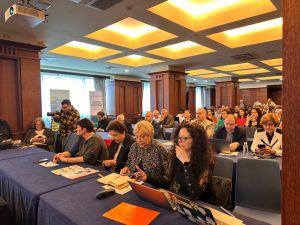
Participants at the national conference “Financing Energy Efficiency: The National Building Renovation Plan and the Role of Local Authorities”, Sofia, 17 March 2026 © EnEffect
Establishing the Framework: A Long-Term Vision for Renovation
A central moment of the conference was the presentation and first expert discussion of the draft National Building Renovation Plan, designed as a long-term policy framework with a horizon of 25 years.
The discussions highlighted the scale and urgency of the challenge. Bulgaria currently has around 267.5 million m² of residential floor area, with a significant share requiring renovation, alongside approximately 76 million m² of non-residential buildings.
To meet national and European targets, the country must renovate more than 79 million m² of residential space by 2035, while achieving a 20-22% reduction in primary energy consumption in the residential sector.
These figures clearly demonstrate that building renovation in Bulgaria is not a short-term programme, but a structural transformation requiring long-term planning, stable policies, and coordinated action across institutions.
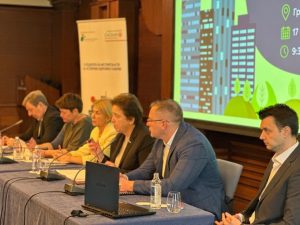
Panel speakers (from left to right): Nikolay Nalbantov (Director, Energy Strategies and Policies for Sustainable Energy Development, Ministry of Energy), Malina Krumova (Deputy Minister of Environment and Water), Tanya Hristova (Mayor of Gabrovo, Chair of the EcoEnergy Municipal Network), Dora Yankova (Deputy Minister of Regional Development and Public Works), Dragomir Tzanev (Executive Director, EnEffect), Dimitar Ganev (Chair of the Board, National Decarbonisation Fund), during the national conference “Financing Energy Efficiency: The National Building Renovation Plan and the Role of Local Authorities”, Sofia, 17 March 2026 © EnEffect
Introducing MEPS: Targeting the Worst-Performing Buildings
A key pillar of the draft plan is the introduction of Minimum Energy Performance Standards (MEPS) for non-residential buildings.
The proposed approach focuses on the gradual renovation of the least efficient buildings, targeting:
- the worst-performing 16% of the building stock by 2030,
- and 26% by 2033.
This staged implementation allows for a realistic transition, while ensuring that the buildings with the highest energy consumption and savings potential are addressed first.
MEPS are therefore positioned not only as a regulatory requirement, but as a strategic tool to accelerate decarbonisation and improve overall building performance in a structured and measurable way.

Panel speakers (from left to right): Kamen Simeonov (Project Manager, EnEffect), Tzveta Naniova (Executive Director, Bulgarian-Austrian Consulting Company – BACC), Ivaylo Aleksiev (Executive Director, Sustainable Energy Development Agency – SEDA), Dragomir Tzanev (Executive Director, EnEffect), during the national conference “Financing Energy Efficiency: The National Building Renovation Plan and the Role of Local Authorities”, Sofia, 17 March 2026 © EnEffect
From Analysis to Policy: The Contribution of REDESIGN
During the conference, EnEffect presented key findings developed under REDESIGN project, supported by the European Climate Initiative (EUKI).
The analysis provides practical guidance for implementing MEPS in Bulgaria, highlighting several critical conditions for success:
- improved availability and quality of building data;
- establishment of a robust monitoring and control system;
- clearly defined institutional responsibilities;
- introduction of step-by-step renovation pathways to support building owners.
These renovation pathways are particularly important, as they offer flexibility – allowing building owners to progressively meet requirements instead of facing immediate, high investment costs.
Importantly, these approaches have already been reflected in the draft National Building Renovation Plan, demonstrating the direct contribution of REDESIGN project to national policy development.
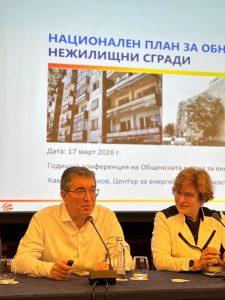
Panel speakers (from left to right): Kamen Simeonov (Project Manager, EnEffect), Tzveta Naniova (Executive Director, Bulgarian-Austrian Consulting Company – BACC) © EnEffect
Mobilising Investment: The Role of the National Decarbonisation Fund
A strong emphasis during the conference was placed on financing as a critical enabler of renovation.
The planned National Decarbonisation Fund was highlighted as a key instrument that will combine grants, guarantees, loans, and technical assistance to mobilise significantly higher levels of investment.
The fund is expected to support households, public buildings, and businesses, while shifting the current model from one-off programmes to a long-term, sustainable financing framework.
As emphasised during the discussion, unlocking private investment and providing accessible financial solutions will be essential, especially given the estimated over EUR 19 billion in total investment needs by 2035.
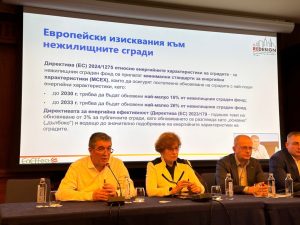
Panel speakers (from left to right): Kamen Simeonov (Project Manager, EnEffect), Tzveta Naniova (Executive Director, Bulgarian-Austrian Consulting Company – BACC), Ivaylo Aleksiev (Executive Director, Sustainable Energy Development Agency – SEDA), Dragomir Tzanev (Executive Director, EnEffect), during the national conference “Financing Energy Efficiency: The National Building Renovation Plan and the Role of Local Authorities”, Sofia, 17 March 2026 © EnEffect
Strengthening Governance: The Role of Municipalities and Coordination
Beyond financing and regulation, the conference highlighted the importance of governance and institutional coordination.
Local authorities were recognised as key actors in implementing renovation policies on the ground. At the same time, speakers stressed the need for:
- stronger interinstitutional coordination,
- better support mechanisms for building owners,
- and accessible “one-stop-shop” services to facilitate the renovation process.
As noted during the opening of the conference, municipalities have already proven their capacity to act as stable and effective partners, but require clear roles and long-term support to fully unlock their potential.
Towards a Sustainable and Inclusive Renovation Transition
The conference marked not only a technical discussion, but the beginning of a broader public dialogue on the future of building renovation in Bulgaria.
The transition ahead requires more than regulatory measures – it calls for a combination of:
- clear policy direction,
- effective financial instruments,
- institutional coordination,
- and active engagement of citizens and local authorities.
In this context, REDESIGN project stands out as a key contributor, bridging analytical work and policy implementation, and supporting Bulgaria in translating European requirements into practical, workable solutions.
As the country moves forward, the insights and tools developed through REDESIGN will continue to play an important role in enabling a more energy-efficient, resilient, and inclusive building stock.